
A burst supply line, failed water heater, or sudden storm can turn a dry property into a health and structural risk within hours. The first priority is not salvaging flooring or furniture; it is making sure people can leave safely while the water source and electrical hazards are controlled.
The phrase Water Damage Restoration Companies covers a wide range of providers, from emergency extractors to firms that manage drying, contents, repairs, and insurance documentation. Comparing those capabilities before authorizing work can prevent a small leak from becoming a concealed mold or structural-damage problem.
For local property owners, Restoration Logistics Centennial is one company to include in that comparison, but the same due-diligence standards apply to any contractor. Ask what will be measured, documented, removed, cleaned, and rebuilt—not simply how quickly a crew can arrive.
What to Do During the First Minutes of Water Damage
Treat standing water as potentially dangerous. Do not enter if water is near outlets, electrical panels, appliances, or damaged wiring. Water contaminated by sewage, flooding, chemicals, or unknown sources also requires protective equipment and professional handling.
Leave immediately and call emergency services if there is structural instability, a gas odor, active sparking, a collapsed ceiling, or rapidly rising water. Do not walk through a flooded basement to reach the electrical panel. Shut off electricity only from a dry, safe location and only if you can do so without contact with water. Otherwise, wait for the utility provider or a qualified electrician.
If it is safe, close the main water valve or the fixture’s isolation valve. A facility manager may also protect unaffected inventory by moving it to a dry area, placing foil or plastic under furniture legs, and stopping foot traffic across wet flooring. Photograph conditions before cleanup when doing so does not expose anyone to danger.
Extraction is urgent when water is shallow, clean, and accessible. It is not a do-it-yourself task when the source is sewage, floodwater, a ruptured sprinkler system, or a structurally compromised area. Wet-dry vacuums and household fans may be inadequate and can spread contamination or drive moisture deeper into assemblies.
Services a Professional Restoration Company Should Provide
A capable provider should explain which of these services are needed:
- Emergency response and inspection: Technicians identify the source, affected rooms, material types, water category, and safety concerns.
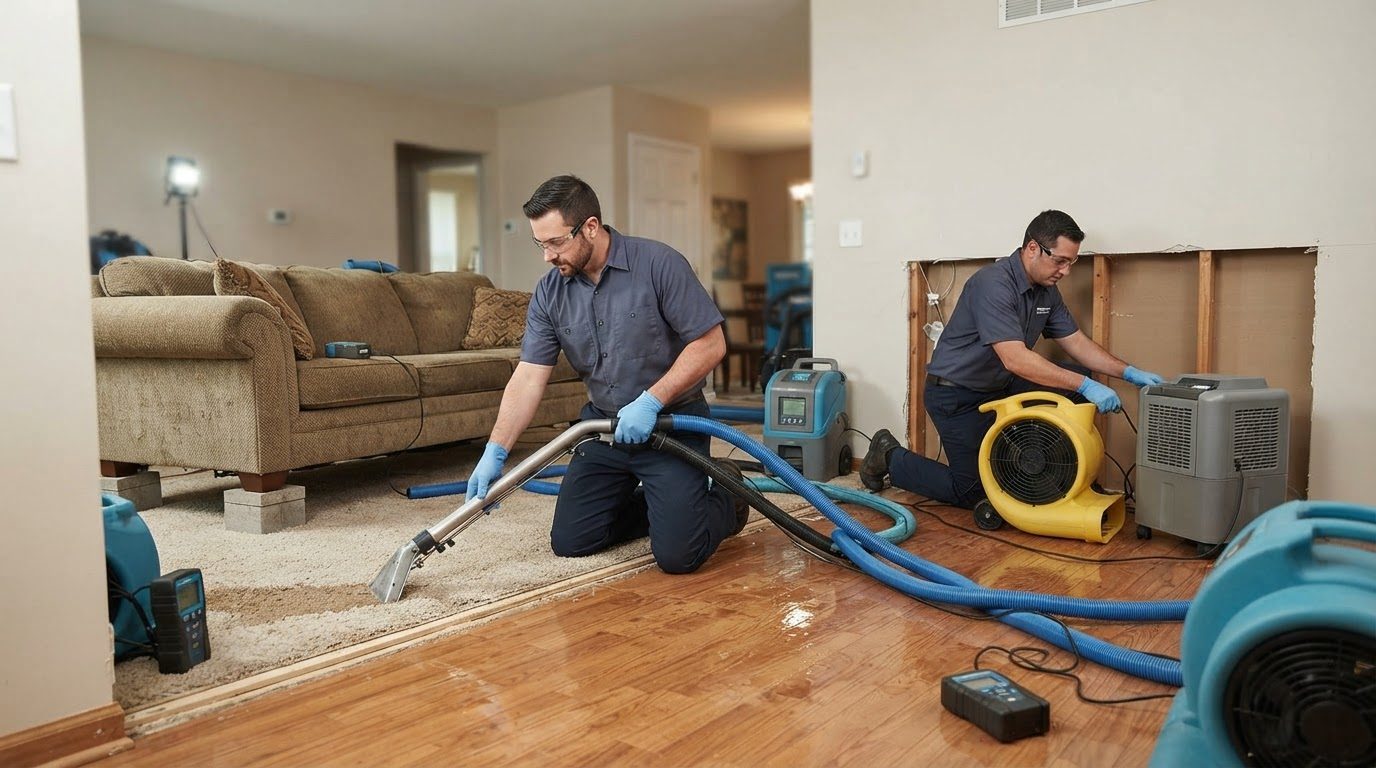
- Water removal: Truck-mounted extractors, portable extractors, pumps, and specialized tools remove bulk water from flooring, carpet, and cavities.
- Structural drying: Air movers increase evaporation while dehumidifiers remove moisture from the air. Technicians should monitor humidity and material moisture, not rely on touch.
- Cleaning and sanitizing: Contents and surfaces may require detergent cleaning, antimicrobial treatment, or controlled disposal. Deodorization addresses odors after the source is removed.
- Repairs and reconstruction: Drywall, insulation, flooring, cabinetry, trim, and paint may require replacement after mitigation.
Mitigation limits immediate damage. Remediation addresses contamination or affected materials. Reconstruction returns the property to its prior condition. Some companies perform all three; others coordinate with specialty contractors.
Common assignments include burst pipes, appliance leaks, failed plumbing, basement and crawl-space flooding, roof or storm intrusion, sewage backups, and commercial losses. Commercial work may require phased drying, inventory protection, tenant coordination, and work outside operating hours.
Contents pack-out is another important capability. Salvageable furniture, documents, electronics, and personal property can be inventoried, cleaned, transported, and stored in a controlled environment. Ask whether the company uses barcoded inventory or a similarly auditable system.
Moisture monitoring must extend beyond visible surfaces. Water can remain behind baseboards, inside wall cavities, under floating floors, beneath carpet pad, in insulation, and around cabinets. In Colorado’s freeze-thaw climate, plumbing breaks in exterior walls and roof-related intrusion after snow or intense summer storms deserve particular attention.
How Water Damage Restoration Is Properly Completed
A defensible restoration workflow generally follows these stages:
- Emergency inspection: The team documents photographs, room dimensions, affected materials, moisture readings, and the likely source. Water is categorized by contamination risk, commonly from clean water to progressively contaminated categories.
- Source control: The leak is stopped or referred to a plumber, roofer, utility, or building engineer. Restoration cannot succeed while water continues entering.
- Extraction: Standing water and saturated contents are removed using pumps, extractors, weighted extraction systems, or other suitable equipment.
- Controlled demolition: Unsalvageable drywall, insulation, flooring, or other porous materials may be removed. Demolition should be justified and documented before disposal.
- Drying: Air movers and dehumidifiers establish airflow and vapor-pressure control. Technicians take repeated readings from affected and unaffected areas and compare them with appropriate dry standards.
- Cleaning and odor control: Surfaces and contents are cleaned and sanitized according to their contamination level. Odor treatment should follow extraction and cleaning, not mask an unresolved source.
- Monitoring and verification: Equipment settings, daily readings, photographs, and changes in affected materials should be recorded. Surface dryness alone does not prove that subflooring, framing, or wall cavities are dry.
- Reconstruction: Once mitigation is complete, qualified trades replace damaged drywall, flooring, cabinetry, insulation, trim, and finishes. The handoff should clearly separate emergency services from repair work.
Look for technicians trained through the Institute of Inspection Cleaning and Restoration Certification (IICRC), particularly in water restoration and structural drying. OSHA safety practices matter for electrical hazards, respiratory protection, demolition, and contaminated materials. If mold is suspected, ask how the firm will coordinate assessment and remediation rather than applying indiscriminate chemicals.
Evaluating Water Damage Restoration Companies
Availability matters, but an advertised 24/7 number is not the same as a staffed emergency response. Ask when a technician can inspect the property, what happens overnight, and whether the company owns extraction and drying equipment or subcontracts it.
Compare providers on:
- Relevant IICRC training and documented field experience.
- General liability, workers’ compensation, and any required state or local licensing.
- Residential, commercial, sewage, contents, and reconstruction capabilities.
- Written inspection findings, photographs, moisture maps, and itemized estimates.
- A named project supervisor and a clear communication schedule.
- Reviews, complaint history, references, and evidence of completed comparable work.
Understand the business structure. A national brand may offer standardized systems and broad resources, while a franchise location operates independently under the brand’s model. An independent contractor may provide strong local expertise but have fewer resources. A locally operated restoration company may offer direct access to ownership and regional knowledge. The relevant question is who is actually responsible for the crew and documentation on your loss.
Be cautious if a provider promises guaranteed insurance coverage, pressures you to sign an assignment without explanation, starts demolition before documenting conditions, or cannot explain its drying plan. A professional company can document damage for an adjuster, but it cannot guarantee that a policy will pay.
Cost, Insurance, and Recovery Expectations
Pricing depends on water volume, contamination, square footage, affected materials, access, emergency timing, equipment duration, contents handling, demolition, and reconstruction. As broad U.S. planning ranges, localized clean-water mitigation may run about $1,000–$4,000; moderate multi-room drying often falls near $4,000–$10,000; extensive flooding, sewage cleanup, or reconstruction can exceed $10,000 and reach tens of thousands. Local labor, material costs, and project complexity can shift those figures substantially.
Mitigation and repairs are often evaluated separately. Extraction, drying, and cleaning may be one scope; replacing cabinets, flooring, drywall, or paint may be another. Obtain both scopes in writing and ask which work is being performed by the restoration company versus a subcontractor.
Insurance commonly distinguishes sudden, accidental damage from gradual seepage, deferred maintenance, wear, groundwater, or flood losses. Coverage, exclusions, endorsements, and deductibles vary by policy. Photograph the source and damage before moving items or discarding materials when safe, and notify the insurer promptly. Do not delay emergency mitigation while waiting for an adjuster if continued water exposure is worsening the property.
A small, isolated leak may be extracted and substantially dried in two to four days, although repairs take longer. Extensive losses may require a week or more of drying, while sewage events add containment, cleaning, disposal, and clearance considerations.
Questions to Ask Before Hiring
- How quickly can the team inspect the property, and who responds after hours?
- What equipment and moisture measurements will be used?
- Will readings be taken behind walls, under flooring, and in concealed areas?
- Will the company handle both mitigation and reconstruction?
- How will sewage or other contaminated water be classified and cleaned?
- What photographs, moisture logs, inventory records, and estimates will be provided for insurance?
- Which materials can be restored, and which must be removed?
- Who supervises the work and communicates drying progress?
The strongest choice is not necessarily the largest company or the lowest initial quote. It is the provider that makes the hazard understandable, controls the source, measures the drying process, documents decisions, and gives you a clear path from emergency mitigation to a safe, completed repair.
