
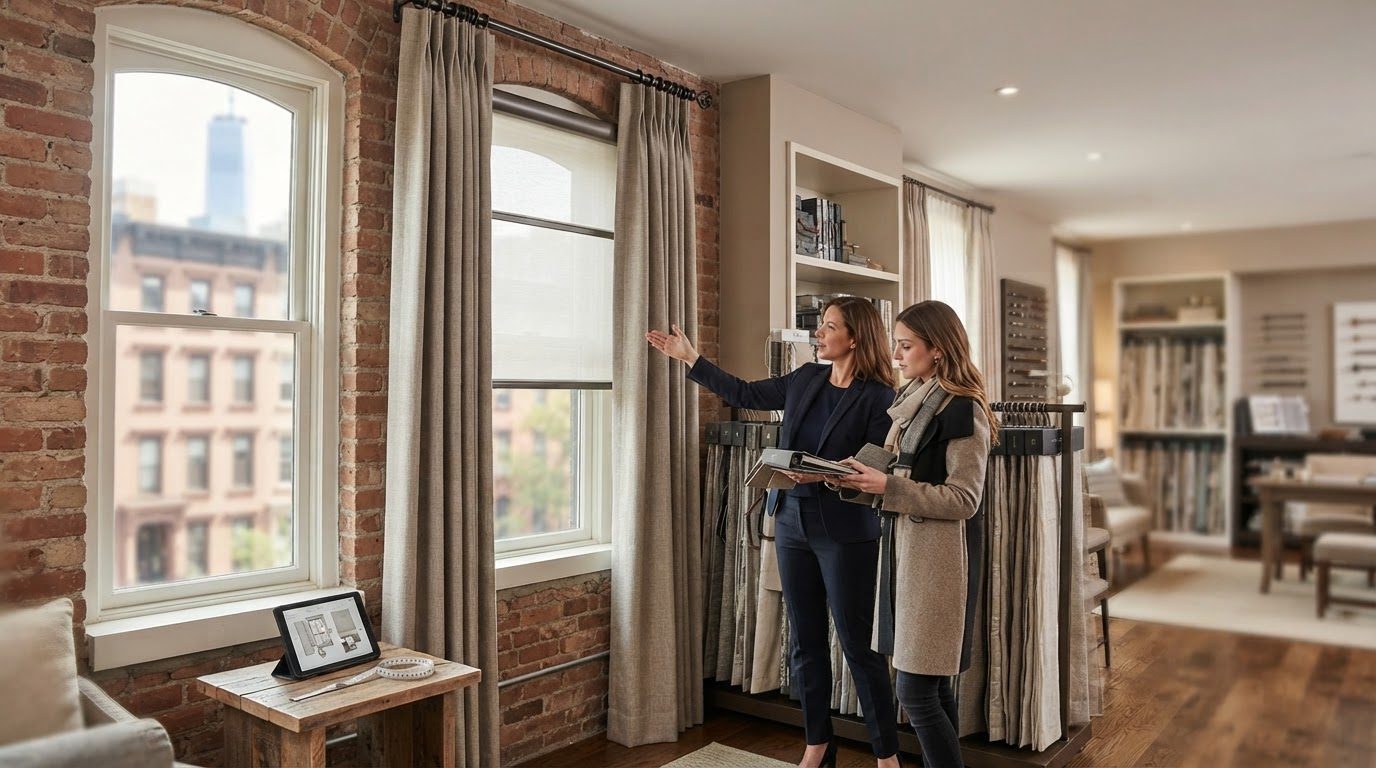
New York windows rarely follow a standard formula. A prewar apartment may have deep trim and a radiator beneath a narrow opening, while a newer high-rise may present floor-to-ceiling glass, intense afternoon glare, and little wall space for hardware.
Searching for a Curtains store New York is only the first step. The more important decision is whether the treatment suits the window’s dimensions, the room’s function, the building’s limitations, and the level of privacy and light control you need.
A useful starting point is to compare fabric samples, operating systems, mounting methods, and installation capabilities rather than choosing by appearance alone. The Blinds Source can be one resource to review as you develop that specification, particularly if your project combines curtains with shades or other window treatments.
Start with the Window—and the Way the Room Is Used
Measure the window as an architectural opening, not simply as a piece of glass. Record the frame width and height, sill depth, casing, ceiling height, radiator location, HVAC registers, window handles, and nearby furniture. In New York apartments, a few inches can determine whether panels hang freely or obstruct heat, airflow, or a door.
Then define the room’s priorities:
- Privacy: Street-facing bedrooms and living rooms may need daytime sheers plus a denser nighttime layer.
- Daylight control: Solar or light-filtering shades can reduce glare without making a room feel dark.
- Insulation: A lined drapery panel can reduce drafts and heat gain, although it will not replace properly sealed windows.
- Acoustics: Full, pleated fabrics absorb some interior reverberation but are not a substitute for building soundproofing.
Terminology matters. Curtains usually describe lighter or unlined panels; drapes are commonly heavier and lined. Roman shades fold into horizontal pleats, roller shades wrap around a tube, and sheers diffuse light while preserving a degree of brightness. Layered treatments combine two or more functions—such as a blackout roller shade behind decorative side panels.
Curtain Styles That Suit New York Interiors
Tailored drapery creates a formal, architectural appearance. Pinch pleats, ripplefold panels, and grommet headings each produce a different stackback and fullness requirement. A ceiling-mounted track can make a low room appear taller, while a rod mounted wider than the frame allows panels to clear the glass when open.
Relaxed linen panels suit contemporary and prewar interiors, adding texture and softness. Linen can crease, stretch, and vary slightly in color, so lining and appropriate fullness are important. It is not always the best choice for intense direct sun or a room requiring complete darkness.
Sheer curtains filter harsh light and soften views into a room. They work well in living areas and can be paired with blackout-lined drapery or a roller shade for nighttime privacy.
Blackout curtains and shades are useful in bedrooms, nurseries, media rooms, and apartments facing illuminated signage. “Blackout” describes the fabric’s light-blocking performance, but edge gaps around the window can still admit light. An inside-mounted shade generally leaves more perimeter leakage than an outside-mounted shade with side channels or overlapping drapery.
Roman shades offer a tailored appearance where wall clearance is limited. Flat-fold styles look crisp; relaxed or hobbled folds provide more softness but project farther into the room. Side panels can add height and decoration without covering the entire window.
For sliding doors, use a bypass or traversing track, vertical cellular shades, or panels that stack clear of the active door leaf. In homes with children or pets, specify cordless shades, inaccessible operating cords, or motorized controls. Cordless does not eliminate every hazard, so hardware should still be installed and operated according to manufacturer guidance.
Custom Solutions for Challenging NYC Windows
Bay and corner windows require a coordinated mounting plan. Separate rods may collide at the corner, while a continuous track can create a cleaner line if the ceiling and returns permit it. Oversized glass may need multiple drapery carriers, spliced tracks, or motorized operators to prevent excessive load on one mechanism.
Unusually shaped windows—including arched, triangular, and angled openings—often suit fixed panels, cellular shades, custom roller shades, or stationary decorative treatments. The appropriate solution depends on whether the glass must open, whether glare is a concern, and how much visual coverage is required.
Windows above radiators demand careful clearance. Fabric should not lie directly over a heat source, and a shade may need to stop above the radiator or project beyond it. Similarly, do not cover HVAC registers or return grilles; blocked airflow can reduce comfort and increase system strain.
Accurate measuring prevents:
- Light gaps at the jambs or sill.
- Uneven hems caused by an out-of-level floor or ceiling.
- Hardware striking trim, handles, or window cranks.
- Panels resting on radiators or blocking ventilation.
- Insufficient stackback that leaves glass permanently covered.
A professional measurement should document three width readings and three height readings where appropriate, note the smallest dimension, and check whether the opening is square. For inside mounts, the installer must also verify recess depth and obstructions. For outside mounts, confirm wall structure and whether anchors are suitable for masonry, plaster, or drywall.
Layering is often the most practical New York solution. A light-filtering roller shade can provide daytime privacy, a blackout shade can darken a bedroom, and decorative panels can soften the room. In a home office, a screen or solar shade may reduce monitor glare while preserving the view; choose its openness factor based on sun exposure and privacy needs.
Motorized Curtains, Shades, and Smart-Home Integration
Motorization is particularly useful for tall windows, broad sliding doors, hard-to-reach glass, or multiple treatments that must operate together. It can also improve accessibility and remove dangling cords.
Systems vary in capability:
- Remote-controlled: Simple point-to-point operation, often appropriate for one room.
- Scheduled: Opens and closes at programmed times, useful for consistent morning light and privacy.
- App-connected: Allows control from a phone and may support scenes or geofencing.
- Integrated: Connects with platforms such as Apple Home, Google Home, Amazon Alexa, Control4, or another professionally configured system.
Ask about motor noise, maximum panel weight, travel limits, battery life, charging access, and manual override. Battery motors simplify retrofit installations but may require periodic charging. Hardwired systems provide continuous power but can require concealed wiring, electrician coordination, and approval from a building manager or cooperative board.
Automation can materially increase project cost. As a broad industry benchmark, a simple manual shade may begin around $150–$400 for a standard opening, while custom Roman shades and premium drapery can range from roughly $700 to several thousand dollars per window. Motorization, specialty fabrics, wiring, complex tracks, and difficult access may add hundreds or thousands more. Treat any online price as an initial planning figure, not a quote.
What to Expect When Visiting a New York Curtains Store
A productive consultation should follow a practical sequence:
- Review privacy, light, insulation, acoustic, and design goals.
- Examine full-size fabric, lining, trim, and hardware samples in natural and artificial light.
- Assess measurements, window operation, radiators, HVAC, trim, and furniture clearance.
- Compare manual and motorized configurations.
- Confirm fabrication, delivery, installation, steaming, and service responsibilities.
Ready-made curtains are faster and less expensive, but standard lengths and widths may produce pooling, exposed gaps, or awkward hardware placement. Made-to-measure treatments cost more but can account for uneven openings, unusual ceiling conditions, exact hem heights, and coordinated layers.
Before ordering, ask:
- What is the expected lead time from deposit to installation?
- Is the quoted fabric suitable for direct sun, moisture, and frequent operation?
- What lining choices are available: unlined, privacy, thermal, room-darkening, or blackout?
- Are alterations, return visits, steaming, and removal of packaging included?
- Who measures, fabricates, installs, and adjusts the treatment?
- What warranty covers fabric, motors, controls, and hardware?
- How are future repairs, battery replacement, or programming handled?
Bring window dimensions, room photographs, paint and upholstery samples, furniture plans, and a realistic budget. Also note elevator restrictions, delivery hours, co-op or condo rules, and whether drilling into ceilings or window trim is permitted—common logistical issues in New York buildings.
When comparing showrooms, design studios, and in-home services, use this checklist:
- Do they offer both curtains and hard treatments when a layered solution is appropriate?
- Can they explain mounting and clearance constraints technically?
- Are samples available to take home?
- Is measurement performed before fabrication?
- Is installation performed by trained personnel with building access experience?
- Are lead times and change-order costs documented?
The right treatment is not necessarily the heaviest, most automated, or most expensive option. It is the one that performs reliably within the window’s physical constraints while supporting how the room is actually used.
