
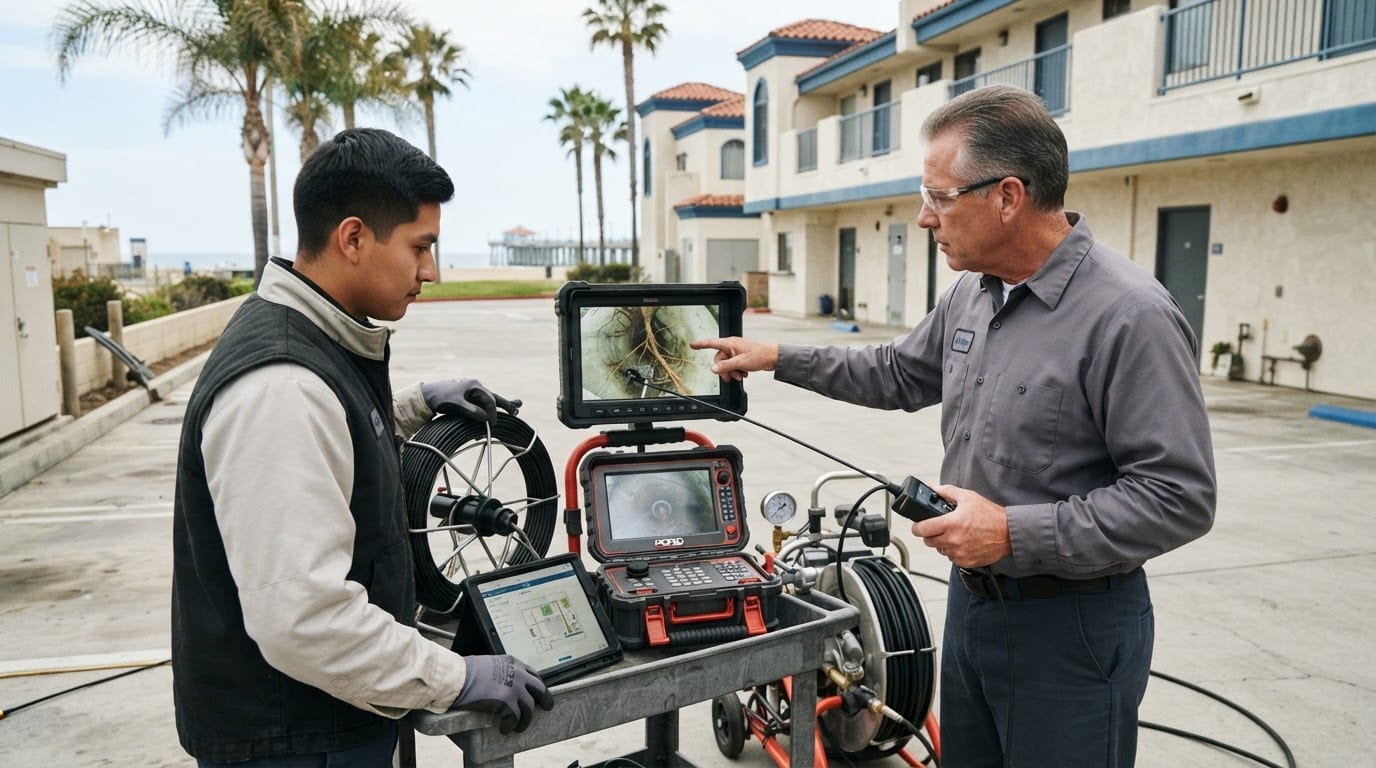
A slow kitchen sink in Huntington Beach can come from a grease film, a root mass at a clay joint, or a sag where sediment has collected for years. These problems look alike from the drain opening, but they call for different equipment and different pressures. A jetting visit is only as good as the decisions made before the hose enters the cleanout.
Hydro jetting Huntington Beach uses a high-pressure water hose and specialized nozzles to scour the inside of a pipe, removing buildup that a snake would leave behind. The method suits grease, sludge, scale, and root intrusion, but it is not the right answer for every line. Knowing which conditions justify it, and which require a different approach, helps homeowners and property managers judge a quote and understand what the crew is doing.
If you are planning a visit, Plumbing by Tony recommends collecting basic details first: which fixtures drain slowly, how often the problem recurs, whether it affects one fixture or the whole house, and where the cleanout is located. Photos of the cleanout and any recent backup give the technician a useful starting point before the camera goes in.
Start With the Camera, Not the Pressure
A camera inspection usually comes before any water enters the line because pressure is not neutral. Residential jetters commonly operate in a range of roughly 1,500 to 4,000 PSI, and a pipe with a crack, offset, or soft wall can fail under force that a sound pipe handles without trouble. The camera shows whether the jetting plan is safe and what the cleaning should accomplish.
Reading the Footage Before the Job
Before setting pressure and nozzle, the crew identifies the pipe material and the type of blockage. Common materials in older Huntington Beach homes include:
- Vitrified clay pipe, which is brittle and prone to joint separation
- Cast iron, which resists high pressure well but accumulates scale that requires descaling heads
- Orangeburg (bituminous fiber) pipe, which softens with age and can be damaged by aggressive jetting
- ABS or PVC, which tolerates jetting well but can still have failed joints
Footage also shows the deposit type. Grease appears as a smooth, coating layer along the crown and sidewalls. Roots appear as fibrous masses entering at joints. Scale looks hard and crusted, while silt forms a flat bed at low points or bellies. Each suggests a different nozzle and pass count.
The crew should watch for specific warning signs on damaged pipe: active offsets where a joint has dropped, cracks that run longitudinally, sections where the wall is visibly thin, and any point where the camera cannot pass without force. Those findings may call for reduced pressure, a slower advance, or a recommendation for repair before jetting. Request a copy of the inspection footage, and ask whether the report uses NASSCO PACP (Pipeline Assessment Certification Program) defect coding, a widely used standard for sewer condition reporting.
Confirming the Result With a Second Pass
A post-jetting camera check shows three things: whether the wall is clean, how much buildup remains, and whether the line needs a follow-up schedule. A clean pipe with no remaining grease ring suggests a one-time cleaning was enough. Thin residue points toward a shorter maintenance interval. Roots that were cut but not removed from a joint indicate the problem will return.
Matching the Blockage to the Right Method
A cable, or snake, bores a hole through a clog and leaves the rest of the deposit on the pipe wall. Jetting cleans the full circumference, which is why it performs better on grease films and sludge that would otherwise reform. A cable still has a place in certain situations, such as retrieving a solid object or working through a fragile pipe where water pressure carries more risk than a mechanical tool.
Nozzle selection follows the deposit:
- Penetrating or sewer nozzles with rear-facing jets push debris forward and clear general sludge and light grease.
- Root-cutting heads use rotating or fixed cutters to slice roots at joints, with flushing to remove the cuttings.
- Descaling chain or carbide heads remove hardened scale from cast iron and restore bore diameter.
- Flushing heads suit silt and sand in storm drains, catch basins, and floor drains.
Matching the head to the deposit prevents the common error of using a root cutter in a grease line or a high-pressure descaler on fragile clay.
Huntington Beach Conditions That Shape Drain Trouble
Local housing stock, soil conditions, and land use all influence which drain problems come up most often. The details below reflect general patterns in coastal Orange County; homeowners should confirm specifics such as a home’s construction era through county permit records.
Older Homes and Root-Prone Laterals
Many established neighborhoods contain homes built during the mid-twentieth century, with original clay or cast iron sewer laterals running from the house to the street connection. Clay sections are made in short lengths joined by bell-and-spigot connections. Over decades, those joints can shift, crack, or open, creating an entry point for roots seeking moisture.
Roots tend to return through the same joints because the gap that admitted them remains. Jetting removes the visible mass, but it does not repair the joint. That is why long-term planning matters. Options include a camera-based maintenance interval, spot repair of the failed section, or trenchless lining. Lining requires a clean wall, so jetting is often the first step before a liner is installed.
Coastal soils and groundwater also matter. In some low-lying blocks near the coast, shallow groundwater and saturated bedding can contribute to pipe movement over time, which accelerates joint displacement. A camera survey is the most reliable way to see whether a lateral is sagging or shifting.
Commercial Grease and Storm Drain Concerns
Restaurant-heavy corridors generate grease loads that build up in a different way from residential drains. In commercial kitchens, fats cool and solidify along the pipe wall, especially where a line runs horizontally or has low spots. Over time the buildup narrows the bore and traps food solids. Local fats, oils, and grease (FOG) programs and the California Plumbing Code require interceptors and maintenance records for many food service operations.
Storm drains, curb inlets, and yard drains behave differently. Sand, leaves, and fine silt wash in during heavy rain and settle wherever flow slows. The result is not a greasy film but a dense sediment bed that flushing and vacuum recovery remove more effectively than a root cutter would. Private yard drains and catch basins are typically the property owner’s responsibility, separate from city-maintained public storm infrastructure, so the owner should confirm which system a blockage affects before scheduling work.
Frequency, Water Use, and Keeping the Line Clear
Most residential lines need jetting only when they cause trouble. Lines with a known pattern, such as root-prone laterals or grease-producing kitchens, follow a more predictable schedule. Typical intervals include:
- Root-prone clay laterals, once or twice a year
- Commercial kitchen lines, every one to six months depending on volume
- Apartment kitchen stacks, about once a year, with floor-by-floor scheduling
- Storm drains and catch basins, after seasonal rain or when sediment is visible
Water use depends on equipment size. Small electric jetters may flow about 2 to 4 gallons per minute, cart-mounted units roughly 4 to 8, and trailer units 12 to 18 or more. A typical residential job uses a few hundred gallons in total. In a water-conscious region such as Southern California, where supply is shaped by drought conditions and water district rules, it is reasonable to ask whether the equipment carries its own tank and how much water a visit will consume.
Duration of results depends on cause:
- One-time flush of wipes or a foreign object: The line may stay clear for years if the habit that caused it stops.
- Heavy grease loads: Buildup often returns within a few months to a year, sooner in busy kitchens.
- Root intrusion: Clearing works until roots regrow through open joints, often within a year or two without a repair.
- Sags or low slope: Sediment recollects at the low point, so jetting provides only temporary relief without regrading or repair.
Typical costs in Southern California for a residential jetting visit often fall in the range of several hundred dollars, while a camera inspection may add a separate charge. Commercial kitchen visits cost more because of access, service hours, and volume. Treat these ranges as starting points and compare written quotes that itemize camera work, jetting, and any disposal fees.
Commercial and Multi-Unit Scheduling Considerations
Commercial jetting depends on sequence and timing in ways a single residential call does not. A restaurant cannot shut down its dish line for an extended period, so crews typically schedule work during closed hours or early morning. Kitchens also require coordination on which fixtures are isolated, how wastewater is contained, and how access points are protected.
Related maintenance points often matter as much as the main line:
- Floor sinks collect spillage and grease at the surface and should be cleaned before buildup reaches the branch.
- Grease traps and interceptors require pump-out on a schedule, with the inlet and outlet lines jetted to keep fats from passing into the main.
- Floor drains in shops, garages, and basements collect silt that can migrate into the branch.
Multi-unit buildings add a stack-level problem. A kitchen stack may serve several floors, and a blockage at one level can affect others. Crews often work floor by floor, cleaning each branch and then the common stack, which requires coordinating access with tenants and building management. Stack-level planning also determines whether the camera should inspect the vertical run before or after the branches.
Recurring schedules should be set by evidence rather than habit. The first camera check after a commercial visit shows how quickly buildup returns and whether the interval should be shorter or longer. Ask the contractor to verify licensure with the California Contractors State License Board, since plumbing work requires a C-36 license, and confirm that the company carries insurance appropriate to commercial access.
